


Full articles
Articles are organised by publication year. Each entry lets you read the abstract, visit the journal’s article page and download the available PDF and supplementary materials.
2026
An unusual titanosaur axis from the Upper Cretaceous of Brazil and its significance for sauropod anatomy and systematics
Bruno A. Navarro, Jeffrey A. Wilson Mantilla, Jhonata H. A. Martins, Fabiano V. Iori, Leonardo S. Paschoa, Alberto B. Carvalho, Joseli M. Piranha & Hussam Zaher (2026).
The Anatomical Record, ar.70118.
Abstract
The Upper Cretaceous São José do Rio Preto Formation (Bauru Group, south-eastern Brazil) has yielded a fragmentary but taxonomically diverse record of titanosaur sauropods, although elements from cervical series remain scarce. Here, we describe a nearly complete sauropod axis from the Vila Ventura Paleontological Area, representing an uncommon occurrence within this unit and the Bauru Group as a whole. The Vila Ventura axis exhibits a broad axial intercentrum with paired ventral fossae, an elongated, goblet-shaped axial pleurocentrum that is longer than high, and a tall neural arch. Microcomputed tomography imaging reveals extensive camellate-type internal pneumaticity, including radial and circumferential camellae in the pleurocentrum with incipient development of internal bony plates—traits that are previously found in highly nested titanosaurs, such as saltasaurines. Comparative osteological analysis, however, indicates closer affinities with colossosaurians (e.g., Bonitasaura, Futalognkosaurus, Pitekunsaurus), particularly in centrum proportions and laminar configuration, including an enlarged odontoid, a V-shaped ventral median keel with ventrolateral excavations in the pleurocentrum, a stout prespinal lamina terminating in an anterior spinal projection, and well-developed pneumatopores in the spinodiapophyseal fossae. Additionally, the specimen exhibits unique features, such as a stranded and laterally expanded spinoprezygapophyseal lamina and a transversely broad anterior spinal projection. An evaluation of axis morphology highlights the underrepresentation of phylogenetic characters from this element in current datasets, despite its potential diagnostic value for assessing lower-level relationships within Titanosauria. This discovery increases the diversity of Brazilian titanosaur records and emphasizes the importance of axial elements in understanding sauropod functional morphology and phylogeny.
A new titanosauriform with European affinities in the Early Cretaceous of Brazil: insights on Somphospondyli phylogeny, histology and biogeography
Elver L. Mayer, Julian C. G. Silva Junior, Leonardo R. Kerber, Bruno A. Navarro, Kamila L. N. Bandeira, Juan C. Cisneros, Eliane P. Sousa, Agostina A. Pereira, Manuel A. Medeiros, Rafael M. Lindoso, Francisco Pedro Cavalcanti Neto, Aline M. Ghilardi, Tito Aureliano, Pedro L. Godoy, Gabriel S. Ferreira & Max C. Langer (2026).
Journal of Systematic Palaeontology, 24(1), 2601579.
Abstract
A non-titanosaur Somphospondyli specimen unearthed from Early Cretaceous (Aptian) deposits of north-eastern Brazil allowed the establishment of a new taxon, Dasosaurus tocantinensis gen. et sp. nov. Shared synapomorphic traits, notably a complex of three anteroposteriorly elongated ridges in the middle and posterior caudal vertebrae, with a groove above the ventral one, and a well-developed lateral bulge on the femur, support the position of the new sauropod as sister to Garumbatitan morellensis, from the Barremian of Spain. Osteohistological patterns recognized in D. tocantinensis include a mixture of traits previously recognized separately in early diverging neosauropods and later titanosaurs, including an external fundamental system and remains of primary laminar tissue, along with a high degree of secondary remodelling. Apart from expanding the known diversity of Early Cretaceous sauropods in the northern part of South America, this discovery highlights biogeographical connections with more northern Gondwanan areas, as well as Europe. In fact, numerical biogeographical analyses suggest that the clade formed by D. tocantinensis and Ga. morellensis had a European origin, with the lineage including D. tocantinensis dispersing to South America via northern Africa at some point between the Valanginian and Aptian.
2025
New lithostrotian specimens (Neosauropoda: Titanosauria) from the Mato Grosso State (western Brazil) and comments about tail injuries in sauropod dinosaurs
Letícia Lacerda, Kamila L.N. Bandeira, Bruno A. Navarro, Maria L.P. Bertolossi, Valéria Gallo, Rafael C. da Silva, Diogenes de A. Campos & Alexander W.A. Kellner (2025).
Journal of South American Earth Sciences, 153, 105336.
Abstract
Titanosaurs were a highly diverse group of sauropod dinosaurs, with hundreds of bones known from Brazil, mostly found isolated. The majority of them come from the Upper Cretaceous Bauru Basin, in southeastern Brazil. However, even though the Mato Grosso State (Midwest Brazil) provides the first historical findings of titanosaurs reported in the country, most of the recorded specimens remain undescribed. Here, we present newly titanosaur specimens collected in the 1950s in the Upper Cretaceous Cambambe Basin, near the Pedra Grande Creek, Chapada dos Guimarães municipality. The specimens are housed at the Museu de Ciências da Terra (Rio de Janeiro, Brazil) and comprise four incomplete caudal vertebrae and two portions of appendicular bones, including a probable fragmentary left ilium, which cannot be assigned to the same individual. Comparisons with more complete taxa allow us to identify this material as representative of two distinct morphotypes, both exhibiting a combination of primitive and derived morphological features. Additionally, the two caudal elements of Morphotype 1 present some pathological features, such as subchondral cysts, being the third case of this paleopathology reported in titanosaurians. Despite being fragmentary and lacking diagnostic features at a genus level, these new specimens demonstrate that Mato Grosso State holds great potential for the discovery of more material that can contribute to titanosaurian paleobiology.
A new pterosaur mandible from the Lower Cretaceous of Brazil, and its implications on the taxonomy of the genus Anhanguera (Pterosauria, Anhangueridae)
Lucas C. Piazentin, Bruno A. Navarro, R.V. Pêgas, Alberto B. Carvalho & Hussam Zaher (2025).
Journal of South American Earth Sciences, 165, 105684.
Abstract
Pterosaurs are extinct archosaurs specialized in an active flight lifestyle, with more than half of the species described classified as pterodactyloids. Much of the anatomical knowledge on pterodactyloids originated from specimens collected in the Cretaceous deposits of South America. The Araripe Basin in Northeastern Brazil holds a remarkable record, particularly within the Aptian–Albian Crato and Romualdo formations, from which numerous specimens have been assigned to the genus Anhanguera. To date, three species from this unit are recognized as valid based on relatively complete specimens: A. blittersdorffi, A. piscator, and A. spielbergi. Here, we describe a new anhanguerid specimen from the Romualdo Formation, comprising an almost complete lower jaw and elements of the hyoid apparatus. MZSP-PV 368 is assigned to Anhanguera based on the presence of a well-developed ventral mandibular crest, specific alveoli count, and tooth morphology. The specimen has an overall shape of the crest that is unique among ornithocheiromorphs and supports its referral to A. robustus, a species recently considered a nomen dubium. Phylogenetic and morphometric analyses of MZSP-PV 368 further support its affinity with A. robustus, highlighting the diagnostic value of mandibular crest morphology in anhanguerid taxonomy. These findings indicate that A. robustus represents a diagnosable taxon, herein recognized as a valid species. However, the taxonomy of the genus Anhanguera remains unresolved and will require additional specimens with a greater degree of anatomical overlap for further clarification.
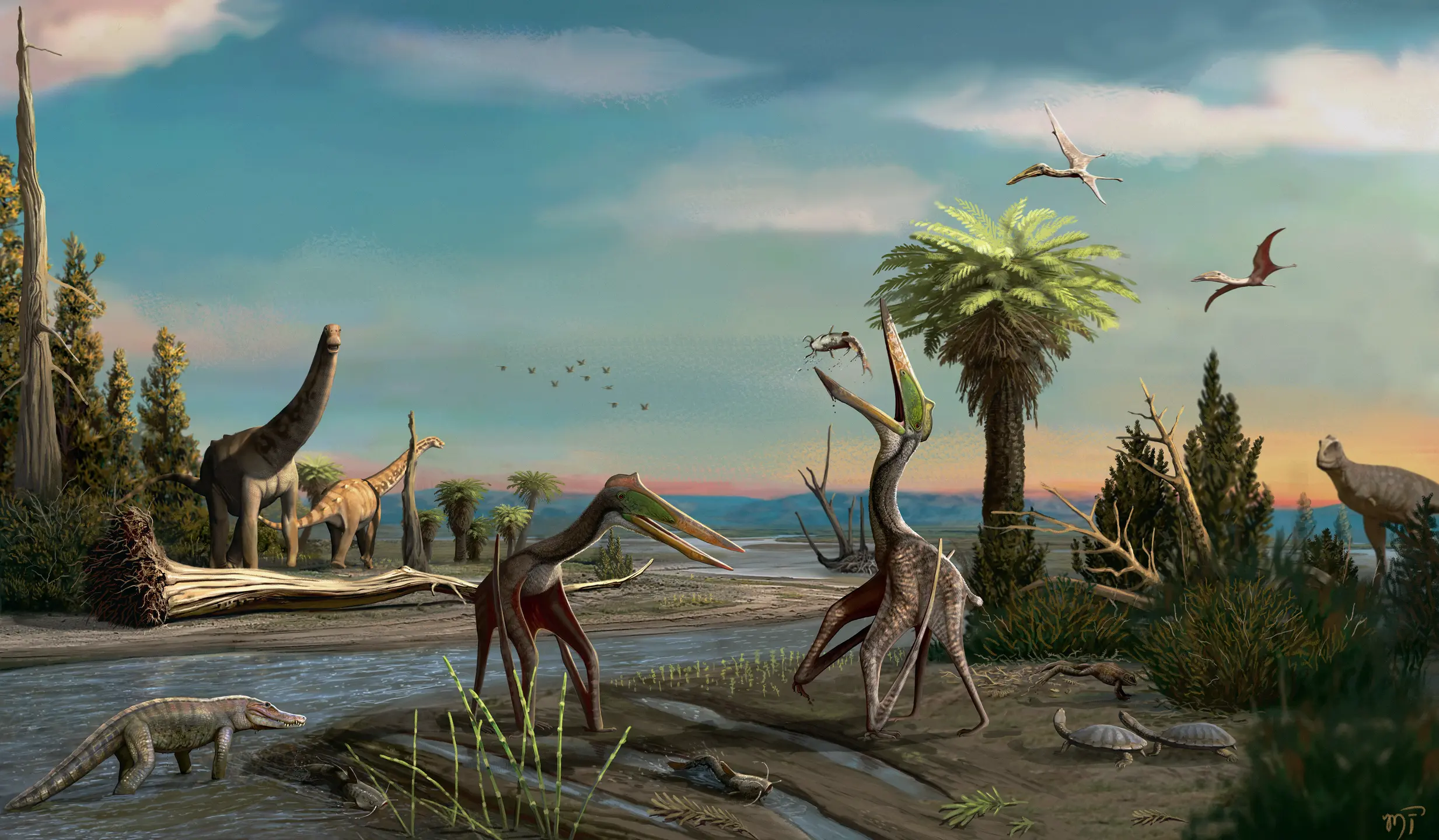
The first pterosaur from the Bauru Group: an azhdarchid from the Upper Cretaceous of Brazil
Ariovaldo A. Giaretta, Bruno A. Navarro, Thiago S. Marinho & R. Vargas Pêgas (2025).
Papers in Palaeontology, 11(5), e70039.
Abstract
The vertebrate fossil record of the Bauru Group (Upper Cretaceous, southeastern Brazil) is remarkably rich, with a predominance of titanosaurs and crocodyliforms, alongside theropods, turtles, squamates, fishes and even small mammals. In contrast, pterosaur remains from the Bauru Group have remained elusive until now. Here, we describe a fragmentary jaw from the upper Maastrichtian Serra da Galga Formation, representing the first confirmed pterosaur discovery from the Bauru Group. The specimen was collected in the Serra da Galga Geosite and is interpreted as a rostrum (upper jaw tip), showing diagnostic features that support its identification as a new azhdarchid species: Galgadraco zephyrius gen. et sp. nov. This new taxon represents the first Brazilian azhdarchid and bears striking similarities to the coeval Albadraco tharmisensis from the Hațeg Basin, Romania. Phylogenetic analysis recovered Galgadraco as a sister taxon to Albadraco, both deeply nested within the clade Quetzalcoatlida. Additional indeterminate pterosaur fragments were also recovered from the same level of the fossil site and include another jaw fragment, a diminutive (? hatchling) lower jaw with azhdarchid affinities, a distal metacarpal IV, and ungual fragments. This highlights a previously unrecognized archosaurian diversity, with important implications for the palaeoecology of the Serra da Galga Formation.
First dinosaur ichnofauna from the Bauru Group indicates Cenomanian–Turonian events led to an ‘Ornithischian Hiatus’ in the Upper Cretaceous of Southeast Brazil
Bruno A. Navarro, Ariovaldo A. Giaretta, Marcelo A. Fernandes, Alberto B. Carvalho & Hussam Zaher (2025).
Cretaceous Research, 168, 106075.
Abstract
The Cenomanian–Turonian interval represents a critical period of faunal change during the Late Cretaceous. Although the main causes of this turnover are contentious, it is undeniable that these global events significantly influenced the last stages of dinosaur evolution. The Bauru Group in southeastern Brazil is known for its rich body-fossil record of crocodyliform and dinosaur remains, representing a key geological unit for understanding the evolution of continental biotas in the Upper Cretaceous of Gondwana. However, the ichnological record in these units are scarce, primarily consisting of invertebrate burrows and rare tetrapod traces. This study focuses on the newly discovered tracksite within the Cenomanian–Turonian Santo Anastácio Formation, marking the first dinosaur ichnofauna identified in the Bauru Group. The new ichnocoenosis includes four theropod morphotypes, a quadrupedal and a small bipedal ornithischian, bipedal and graviportal ornithopods, and a small, narrow-gauged sauropod trackmaker. These tracks provide new insights into the dinosaur faunas during the Cenomanian–Turonian interval and highlight the existence of clades not previously identified in the Bauru Group, particularly ornithischians. The absence of body fossils of these taxa in the younger strata of the Bauru Group indicates that the successive environmental fluctuations during the Cenomanian–Turonian may have been responsible for regional extinctions or migration of these animals to higher latitudes. This ecological shift might have allowed specialized crocodyliforms like sphagesaurians to fill the niches left by small herbivorous dinosaurs in the Bauru Group, while titanosaurians dominate the medium-to-large herbivore roles in these ancient ecosystems.
A reassessment of the historical fossil findings from Bahia State (Northeast Brazil) reveals a diversified dinosaur fauna in the Lower Cretaceous of South America
Kamila L. N. Bandeira, Bruno A. Navarro, Rodrigo V. Pêgas, Natan S. Brilhante, Arthur S. Brum, Lucy G. de Souza, Rafael C. da Silva & Valéria Gallo (2025).
Historical Biology, 37(3), 548-589.
Abstract
Supposed dinosaur remains were collected between 1859 and 1906 in the Lower Cretaceous Recôncavo Basin (Northeast Brazil). Since these materials remained undescribed, and most were considered lost. Recently, some of these historical specimens were rediscovered in the Natural History Museum of London, providing an opportunity to revisit them after 160 years. The specimens come from five different sites, corresponding to the Massacará (Berriasian-Barremian) and Ilhas (Valanginian-Barremian) groups. Identified bones comprise mainly isolated vertebral centra from ornithopods, sauropods, and theropods. Appendicular remains include a theropod pedal phalanx, humerus, and distal half of a left femur with elasmarian affinities. Despite their fragmentary nature, these specimens represent the earliest dinosaur bones discovered in South America, enhancing our understanding of the Cretaceous dinosaur faunas in Northeast Brazil. The dinosaur assemblage in the Recôncavo Basin resembles coeval units in Northeast Brazil, such as the Rio do Peixe Basin, where ornithopods coexist with sauropods and theropods. This study confirms the presence of ornithischian dinosaurs in Brazil based on osteological evidence, expanding their biogeographic and temporal range before the continental rifting between South America and Africa. Additionally, these findings reinforce the fossiliferous potential of Cretaceous deposits in Bahia State, which have been underexplored since their initial discoveries.
2022
A new nanoid titanosaur (Dinosauria: Sauropoda) from the Upper Cretaceous of Brazil
Bruno A. Navarro, Aline M. Ghilardi, Tito Aureliano, Verónica Díez Díaz, Kamila L. N. Bandeira, André G. S. Cattaruzzi, Fabiano V. Iori, Ariel M. Martine, Alberto B. Carvalho, Luiz E. Anelli, Marcelo A. Fernandes & Hussam Zaher (2022).
Ameghiniana, 59(5), 317–354.
Abstract
Titanosaurian sauropods are known to exhibit remarkable body size disparity, with some taxa famed for nearing the zenith of terrestrial vertebrate body size. Here, we describe a new titanosaurian – Ibirania parva gen. et sp. nov. – from the Upper Cretaceous (Santonian–Campanian) São José do Rio Preto Formation of Bauru Basin, in which represents one of the smallest sauropods known to date. The new taxon is diagnosed by seven autapomorphies and had an estimated body length of 5.7 m. Histological and μCT scan analyses showed that this new taxon is represented by skeletally mature individuals, which had attained somatic maturity prior to death. Phylogenetic analyses recovered the new taxon deeply nested within Saltasaurinae, a clade previously known by small-sized forms. Ibirania parva gen. et sp. nov. brings new information indicating that the body size reduction in some titanosaurians could be driven by recurrent ecophysiographical settings, present in South America prior to the diversity peak attained by the group during the Campanian–Maastrichtian.
· · Read article ↗
2021
Exquisite air sac histological traces in a hyperpneumatized nanoid sauropod dinosaur from South America
Tito Aureliano, Aline M. Ghilardi, Bruno A. Navarro, Marcelo A. Fernandes, Fresia Ricardi-Branco & Mathew J. Wedel (2021).
Scientific Reports, 11, 24207.
Abstract
This study reports the occurrence of pneumosteum (osteohistological structure related to an avian-like air sac system) in a nanoid (5.7-m-long) saltasaurid titanosaur from Upper Cretaceous Brazil. We corroborate the hypothesis of the presence of an air sac system in titanosaurians based upon vertebral features identified through external observation and computed tomography. This is the fifth non-avian dinosaur taxon in which histological traces of air sacs have been found. We provided a detailed description of pneumatic structures from external osteology and CT scan data as a parameter for comparison with other taxa. The camellate pattern found in the vertebral centrum (ce) of this taxon and other titanosaurs shows distinct architectures. This might indicate whether cervical or lung diverticula pneumatized different elements. A cotylar internal plate of bone tissue sustains radial camellae (rad) in a condition similar to Alamosaurus and Saltasaurus. Moreover, circumferential chambers (cc) near the cotyle might be an example of convergence between diplodocoids and titanosaurs. Finally, we also register for the first time pneumatic foramina (fo) and fossae connecting camellate structures inside the neural canal in Titanosauria and the second published case in non-avian dinosaurs. The extreme pneumaticity observed in this nanoid titanosaur contrasts with previous assumptions that this feature correlates with the evolution of gigantic sizes in sauropodomorphs. This study reinforces that even small-bodied sauropod clades could present a hyperpneumatized postcranial skeleton, a character inherited from their large-bodied ancestors.
2020
An Early Cretaceous theropod dinosaur from Brazil sheds light on the cranial evolution of the Abelisauridae
Hussam Zaher, Diego Pol, Bruno A. Navarro, Rafael Delcourt & Alberto B. Carvalho (2020).
Comptes Rendus Palevol, 19(6), 101–115.
Abstract
Abelisaurid theropods dominated the predator role across Gondwana during the Late Cretaceous. They are characterized by highly reduced forelimbs and one of the most specialized cranial morphologies among carnivorous dinosaurs, exemplified by a broad skull, short rostrum, high occipital region, and highly kinetic intramandibular joint, suggestive of a specialized feeding strategy. Late Cretaceous abelisaurids are known from some remarkably complete taxa with well-preserved skulls. However, little is known about the pattern of character transformation that led to their highly modified condition because there are no well-preserved abelisaurids before the Late Cretaceous. Here we report a basal abelisaurid from the Early Cretaceous of Brazil that preserves a complete skull and reveals an early stage in the cranial evolution of the group. It lacks the specialized temporal and mandibular features characteristic of derived abelisaurids, including the kinetic intramandibular joint and knob-like dorsal projection of the parietals.
· · Read article ↗